 Mirana
 investment fit from initial evidence to portfolio support
Mirana invests in early- and growth-stage companies building the programmable systems behind new financial infrastructure. Its thesis joins finance, blockchain and artificial intelligence, while its support model combines long-term capital, strategic partnerships, cross-market connections and selective liquidity. The company or fund stage and the requested support determine what later records should confirm.
Bottom line: A clear starting record separates investment interest from commitment and makes later capital, partnership and portfolio support easier to verify.
Fit begins with the mandate and the requested help
Mirana’s investment boundary depends on the work being funded, not on a broad crypto label. Mirana describes its investment scope as early- and growth-stage companies operating globally. A candidate still needs a clear relationship between its product, market or fund strategy and the investment thesis. Technical sophistication alone does not establish fit when the business model, stage or requested support sits outside that boundary.
An operating company and a fund manager present different starting records. The company has a product, operating plan, ownership structure and financing need. A fund manager instead has an investment thesis, fund structure, selection process and responsibility for portfolio construction. Both paths require evidence, yet the evidence describes different work and should not be blended into one generic pitch.
Early interest is not a commitment. Public interest, a meeting, shared diligence materials or a draft do not prove funded status. A commitment becomes verifiable when the relevant parties execute definitive documents; any closing conditions still determine whether the transaction can close. Until then, the request and supporting record can be corrected without representing capital as committed.
How do Mirana’s thesis and support model connect?
The thesis and support model connect through New Financial Infrastructure, Mirana’s term for systems where finance, blockchain and artificial intelligence converge. The category directs attention toward infrastructure rather than treating every Web3 project as equivalent.
Programmable money covers functions such as stablecoins, payments, foreign exchange, cards and agentic commerce. Tokenized capital markets address activities such as capital formation, trading infrastructure, credit and asset management. Open infrastructure supplies underlying capabilities, including L1 blockchains, identity, privacy, verification and agent rails.
Investment fit is only the first connection. Mirana describes portfolio support through strategic partnerships, networks spanning traditional finance, centralized finance and decentralized finance, connections between Eastern and Western markets and selective liquidity. These channels address different constraints, so an investment discussion should identify the support needed.
A company may need financing but little help with market connections. Another may value access to potential commercial relationships while already having sufficient capital. A fund manager has a different need again: an allocation supports the fund, while the manager remains responsible for selecting investments and operating the portfolio under its own terms.
Support remains conditional. A relevant technology does not make every requested relationship available. Availability depends on whether the operating need, investment stage and intended use of capital fit the mandate.
From initial fit to an observable portfolio state
An investment relationship becomes easier to reconcile when every stage leaves a distinct record. The four stages below organize the visible relationship between fit, evaluation, commitment and portfolio work. They do not claim an unpublished application form or fixed timetable.
| Stage | Observable state | Supporting record |
|---|---|---|
| Initial fit | The thesis, company or fund stage and requested help are described consistently. | A dated presentation and current request summary preserve the starting position. |
| Evaluation | Material claims can be traced to current operating, financial or fund records. | Versioned materials and an open-question log distinguish the latest evidence from older records. |
| Commitment | Definitive documents state the obligations, conditions and participating parties. | Executed agreements and controlled copies preserve the binding record. |
| Portfolio work | Capital and agreed support activities have owners and observable follow-through. | Dated decisions, milestones, reporting and introductions preserve what occurred. |
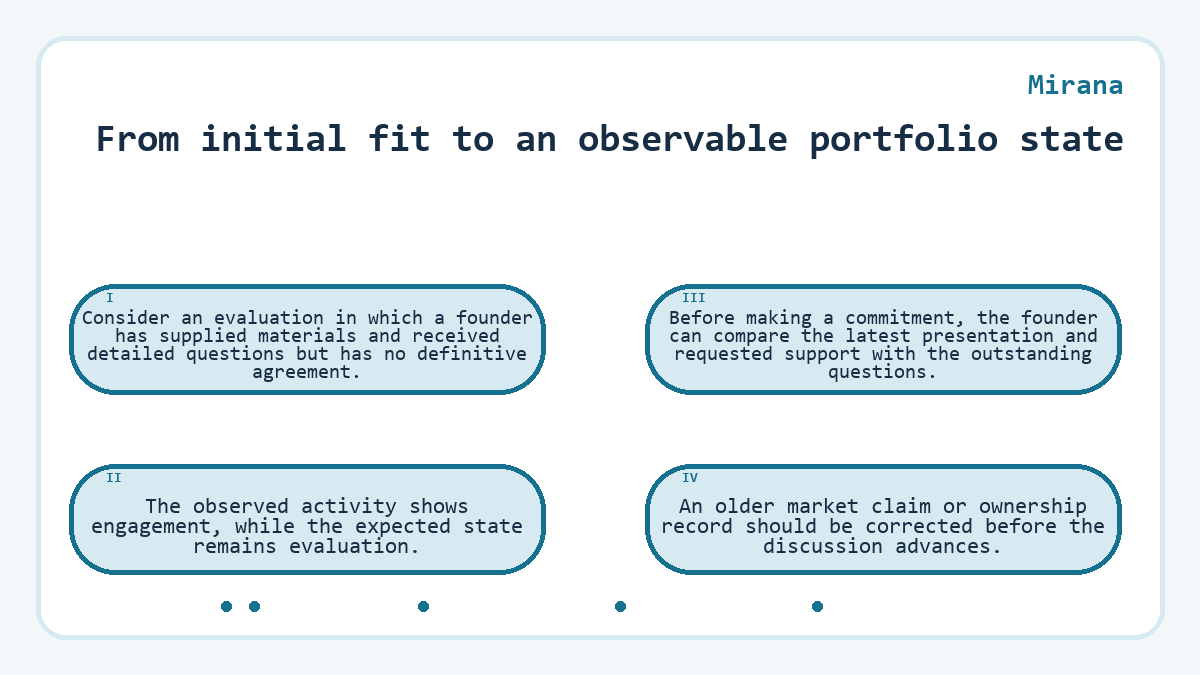
Consider an evaluation in which a founder has supplied materials and received detailed questions but has no definitive agreement. The observed activity shows engagement, while the expected state remains evaluation. Before making a commitment, the founder can compare the latest presentation and requested support with the outstanding questions. An older market claim or ownership record should be corrected before the discussion advances.
Because the commitment point has not been crossed, either side can continue, revise the request or stop without calling the opportunity funded. Once the parties execute definitive documents, the opportunity enters the commitment stage. Satisfying closing conditions and transferring funds are separate checks before it is described as funded. Later records should connect each agreed activity to what actually occurred, rather than relying on the earlier expression of interest.
Capital and strategic support solve different needs
An investment changes a company’s financing position, while Mirana’s portfolio support covers strategic connections, cross-market expertise and selective liquidity. Liquidity support is available to selected portfolio companies rather than promised across the portfolio. Selective availability means a portfolio relationship alone does not establish access to liquidity. A facilitated conversation also differs from a commercial agreement, which requires its own participants and terms. The completed action, not the support category, shows what occurred.
What confirms progress after an investment?
A dated record should show whether the intended support occurred and what changed. The useful evidence depends on the work. A strategic introduction may produce a meeting and follow-up, while a cross-market connection may produce a defined next step and an identified owner.
Support for collaboration needs an agreed objective and a result attributable to the activity being assessed. Selective liquidity support should be checked against the conditions and completed actions in the specific arrangement. These records do not need to turn every conversation into a metric. They need to show whether the promised action occurred and what changed because of it.
Capital has separate completion evidence. Executed documents establish the arrangement, stated conditions determine whether it can close and transaction records show whether funds moved as required. Portfolio reporting can then compare the funded plan with later operating facts without rewriting the original starting point.
When the record and the claimed result differ, preserve the narrower result. If an introduction was discussed but never made, it remains pending or cancelled. If advice was delivered but no implementation was agreed, the record should preserve that narrower result. Evidence requirements differ when support is selective or depends on an outside party.
Where the Web3 focus becomes specific
Its stated focus areas include programmable money, tokenized capital markets and open infrastructure. These areas cover different dependencies. Payment products need reliable movement and settlement of value. Market infrastructure connects issuance, trading, credit or asset management. Open infrastructure provides L1 blockchains, identity, privacy, verification or agent rails. A focus area indicates thematic relevance, but investment fit still depends on the company, stage and proposed relationship.
Reconciliation and a clean stopping point
Reconciliation separates a delay, an evidence mismatch and a genuine lack of fit. A delay preserves the expected state while an action remains outstanding. A mismatch means the available record conflicts with the claim being assessed. Lack of fit means the opportunity or requested support does not match the investment boundary.
A poor fit does not determine the quality of the company or fund. Another source of support may suit the need better. Capital-only backing, a specialist investor, an ecosystem program or an operating partner can address different gaps. The alternative should match the missing capability rather than imitate Mirana’s full combination of capital and strategic support.
Before definitive commitment, a clean stop records the last confirmed state and avoids treating discussions as financing. After commitment, the executed terms govern obligations, changes and any later exit. The appropriate route changes when the requested help falls outside the thesis or the evidence cannot support the claimed state.
Popular questions about Mirana
Can a company without a public token fit Mirana’s mandate?
Yes, a company without a public token can still fall within the stated thesis. Mirana identifies areas such as payments, cards, identity, privacy, verification and financial infrastructure, none of which requires every company to issue a token. Fit still depends on the company’s stage, product and relationship to the investment mandate. The absence of a token alone establishes neither acceptance nor rejection.
Does Mirana use one standard investment amount?
No, Mirana does not describe one standard amount applying to every investment. Mirana publishes check sizes up to $20 million, but that ceiling is not a standard commitment. A specific commitment depends on the opportunity, stage, structure and negotiated terms. Any headline limit is screening context rather than an offer. Only definitive documents establish the amount, timing, conditions and rights for a particular transaction.
Is a strategic partner reference the same as a binding commitment?
No, a strategic partner reference does not create a binding introduction, commercial agreement or distribution commitment. Mirana may facilitate collaboration opportunities with strategic partners for portfolio companies. Any introduction still involves the participating organizations, and a resulting pilot or contract needs separate terms. Progress is shown by the documented action and follow-up, not by a partner name in general investment materials.
Why might an older description of Mirana differ from its current focus?
Investment theses can change as markets, technologies and fund priorities develop. An older description may remain accurate for its date while no longer capturing the present emphasis. Compare dated claims by target company, stage, focus area and type of support. A newer retrieval date alone does not prove a change, but a newer stated mandate can replace an older general description for a current fit decision.
Can a public portfolio entry reveal exact investment terms?
No, a public portfolio entry does not by itself disclose the investment amount, ownership, instrument or continuing obligations. It identifies a relationship at the level Mirana chose to publish. Exact economics require a transaction-specific disclosure or executed record, and absent details should remain unknown. A portfolio name should not imply a round size, approval of every product feature or continuing commercial activity.
Do users open consumer trading accounts with Mirana?
No, Mirana is presented as an investment fund rather than a consumer exchange, wallet or blockchain network. Its work concerns capital allocation and portfolio support for companies and fund managers. A founder may engage around investment fit, while a user seeking to trade, store or transfer digital assets needs a service built for that action. Similar crypto vocabulary does not make those functions interchangeable.
Updated -