 Mirana
 use cases matched to support and timing
Mirana invests long-term capital in companies building new financial infrastructure and offers portfolio companies strategic connections, cross-market expertise and selective liquidity. A use case should begin with one defined task and the smallest form of support suited to it. Timing follows the work, while a named owner, observable evidence and a stop condition prevent support from continuing without a purpose.
This separates financing from operating help. It also shows when a limited request is enough and when evidence from that request justifies a broader commitment.
Completion evidence gives each use case a boundary
A useful application ends in a record tied to the original job: capital committed, an introduction completed, a market question resolved or a selective liquidity arrangement defined.
The evidence changes with the objective. Financing may end at executed documentation and the agreed funding event. A strategic connection needs more than a name passed between two parties; the intended counterpart should accept the interaction and any next action should be recorded. Cross-market help can close when the company has enough information to make the decision named at the start.
Activity without an observable state may show effort, but it cannot confirm the requested job was completed.
Which Mirana use case fits the company’s immediate job?
The best fit comes from the constraint blocking the company now, whether it concerns financing, distribution or navigation between markets and financial models.
Capital for a defined financing need
Capital fits when funding itself is the missing capability and the company can connect it to a stated milestone. Mirana describes check sizes of up to $20 million for investments in early- and growth-stage companies worldwide. That ceiling does not establish a minimum or determine what any company should request. The proposed amount still needs to follow the work, stage and financing plan.
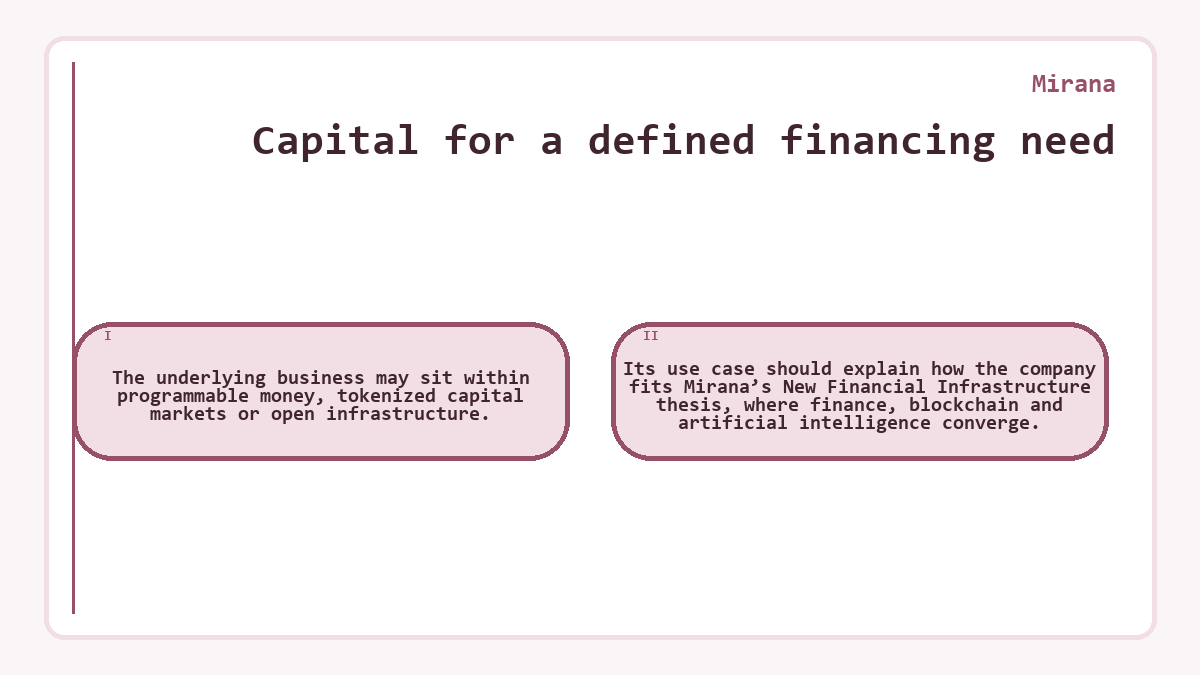
The underlying business may sit within programmable money, tokenized capital markets or open infrastructure. Its use case should explain how the company fits Mirana’s New Financial Infrastructure thesis, where finance, blockchain and artificial intelligence converge.
Strategic access for distribution
Strategic connections fit when the blocked job involves distribution or collaboration rather than financing alone. The request should identify the kind of counterpart needed, the decision the interaction should advance and the company owner prepared to continue the discussion. A broad request for introductions offers no reliable completion test.
Connections across markets and financial models
Cross-market support applies when a company must navigate a real boundary, such as East and West or traditional finance, centralized finance and decentralized finance. The task might concern market entry, operating context or access to the relevant network. Each request needs one destination and one decision, because geographic reach does not remove the company’s readiness obligations.
Capital, connections and liquidity follow different clocks
Set capital timing around the financing milestone it must serve.
Strategic introductions should follow counterpart readiness. The company needs a clear objective, suitable materials and someone able to act on the conversation before an introduction is requested. Repetition makes sense only when a previous interaction created a new, distinct need.
Cross-market help may recur at genuine decision points. A new market question, operating constraint or distribution opportunity can justify another request, while an unchanged question does not become more useful through a standing meeting.
Liquidity has the narrowest trigger because Mirana presents it as selective. Its cadence should follow the accepted case and its observable state, not an assumed schedule attached to every investment.
How should timing follow the job?
Set the next review when new evidence can change the decision, not simply when another calendar interval has passed.
A financing use case may be checked at the relevant milestone. A strategic connection can be reviewed after the interaction and its next action. Cross-market work can pause once the named decision is possible. If repeated support no longer changes the state or removes a constraint, the cadence has outlived the job.
A named owner makes that timing clear. One person should know what evidence is expected, when it will be reviewed and whether the work will continue, change direction or close. This responsibility does not prove success, but it prevents an open request from becoming an indefinite obligation.
A reversible test before broader distribution support
Consider a company whose prospective distribution route has stalled because it lacks the right counterpart. The expected near-term state is modest: a relevant contact accepts a discussion about one defined objective. The company can test that state through a bounded introduction before committing resources to a wider distribution effort.
Compare the bounded and consequential actions
Judge both actions by the same dimensions: objective, readiness, evidence, ownership and stop condition. This keeps the difference in commitment visible.
Action one: test the introduction
The company prepares the context needed for a useful conversation and requests one relevant connection. Completion means the interaction occurs and produces a recorded next action, a clear refusal or evidence the proposed fit was wrong. Any of those states supports a decision without requiring a wider campaign.
Action two: commit only after evidence
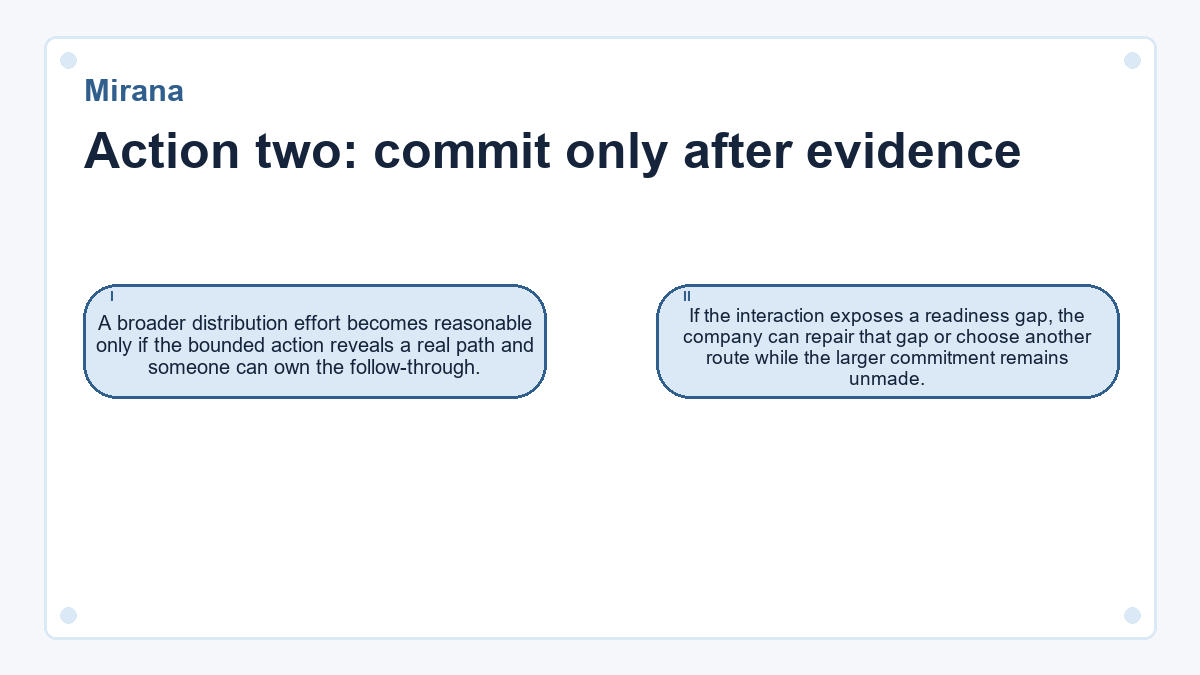
A broader distribution effort becomes reasonable only if the bounded action reveals a real path and someone can own the follow-through. If the interaction exposes a readiness gap, the company can repair that gap or choose another route while the larger commitment remains unmade.
Before choosing the second action, check:
- The blocked distribution decision is stated in one sentence.
- The proposed counterpart has a relevant function.
- The company has the materials needed for the discussion.
- One owner will record the outcome and next action.
- The work stops if no supported path emerges.
This test does not promise distribution. It establishes whether the requested connection creates enough evidence to justify the next commitment.
What changes when liquidity is part of the request?
Liquidity becomes relevant only when the request identifies a specific market function and Mirana accepts the arrangement for that case. Investment capital and liquidity serve different purposes, so a financing relationship does not make liquidity automatic.
Mirana describes liquidity support as available on a selective basis. A usable request therefore identifies the intended function, the prerequisites already in place, the party responsible for monitoring it and the state that will mark completion or reassessment. Without those elements, neither timing nor maintenance responsibility can be set coherently.
Ownership, reconciliation and the stop condition
Every support request needs an owner able to compare the expected state with the actual record. That person should reconcile what happened at the chosen review point and identify any gap without rewriting the original objective after the fact.
The company can correct a missing prerequisite, narrow or revise the request based on new evidence or close the work and choose a functional alternative. Repeating the same action is justified only when a correctable condition explains the first result.
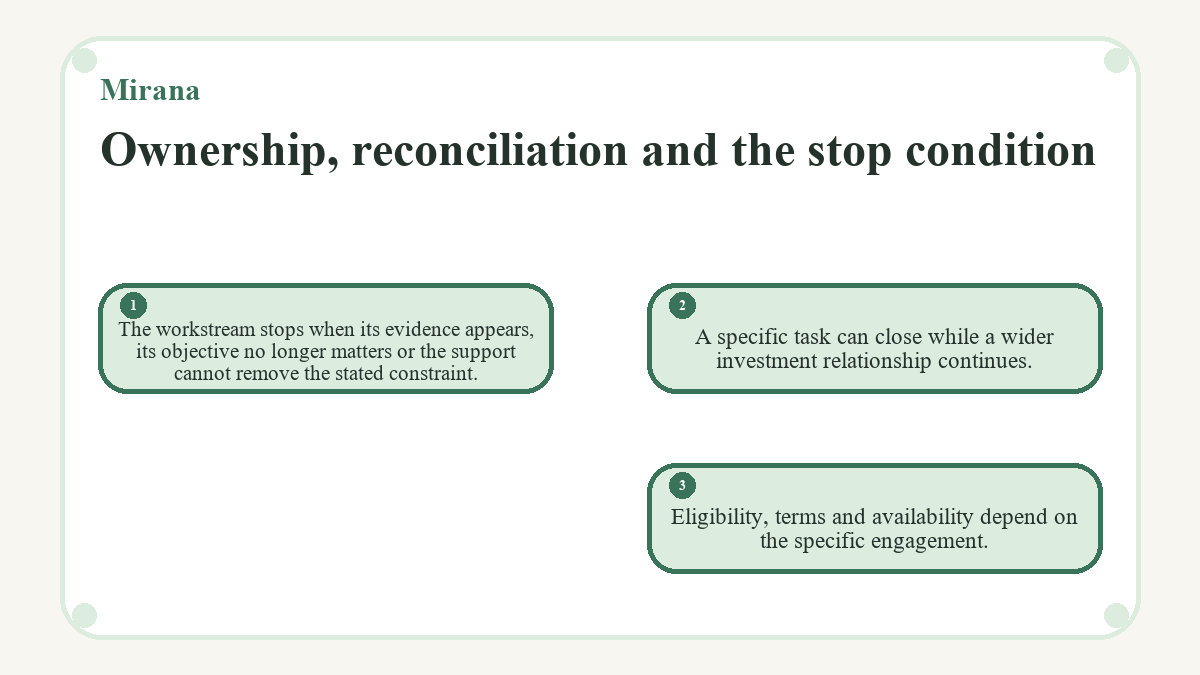
The workstream stops when its evidence appears, its objective no longer matters or the support cannot remove the stated constraint. A specific task can close while a wider investment relationship continues. Eligibility, terms and availability depend on the specific engagement.
Mirana: frequently asked questions
Must a company already be in the portfolio before mapping a Mirana use case?
No. A team can map its objective before an investment discussion because the exercise clarifies what it wants and how completion would be recognized. Mirana describes strategic connections, cross-market expertise and selective liquidity as support for portfolio companies; it does not specify a general standalone route. Actual access, scope and terms depend on the specific engagement.
Can fund managers use the same task-to-support method?
Yes. Mirana states it also invests in fund managers, so the same method can organize a fund-related objective without copying a company use case. The requested capability and evidence should fit the job. A manager seeking strategic connections might record a qualified introduction and agreed next action, while a capital request would need documentation tied to the relevant commitment and milestone.
Could capital and cross-market support belong to one objective?
Yes, if both requests serve the same objective, yet each needs its own evidence and timing. Capital may fund work while cross-market support addresses a distribution or operating constraint. Combining them should not hide the fact that one request can be accepted, delayed or closed independently of the other. Tracking each request separately, with its own evidence and stop condition, keeps the two requests distinct.
Is portfolio inclusion proof of a particular support type?
No. A portfolio entry identifies a relationship displayed by Mirana, but it does not disclose investment terms or establish which support capabilities were used. It cannot prove an introduction happened, liquidity was supplied or a cross-market question was resolved. Use the record created by the specific workstream to judge completion, subject to any confidentiality limits governing that record.
Does Mirana’s global scope remove regional readiness checks?
No. Global scope describes where Mirana may invest, but it does not make every company ready for every regional task. A cross-market request still needs a precise destination, an operational reason for entering it and enough preparation for the proposed interaction. If those prerequisites are missing, the request should pause until the company resolves them.
May private records confirm completion without a public announcement?
Yes. Completion evidence can remain private when the task does not call for public disclosure. A dated meeting record, an accepted next action or executed investment documentation may be enough, depending on the original objective and access rights. The evidence must show the expected state without exposing confidential terms. A public announcement is neither required nor a substitute for the underlying record.
Should internal dependencies shape the requested support date?
Yes. Internal dependencies determine when external support can produce a useful outcome. Product readiness, decision authority, review materials and market constraints may all govern the date, depending on the task. Scheduling an introduction before the company can explain its objective wastes the interaction. Record the blocking dependency, its owner and the condition that makes the request ready to proceed.
Are selective liquidity arrangements based on one standard allocation?
No. Selective availability means the arrangement depends on the particular case; it does not publish a universal allocation, duration or cadence. A company should describe the market function it needs, the readiness conditions and the evidence the arrangement must produce. If those points remain undefined, the liquidity request is not ready merely because an investment relationship exists.
Updated -